
Home » Platform » Health & Safety » Disability Management
Disability Management
Disability and Return-to-Work Management for Enterprise HR
Manage different disability claims like STD & LTD with return-to-work plans in one system connected to safety incident records and job accommodation requests.
Integrates with your native HR system.
- Designed for HR and occupational health teams managing complex caseloads.


Disability Cases Lose Context After a Claim is Filed
The moment an employee files a disability claim, the case moves out of the incident record and into a different system, team, and process.
After safety closes the incident, HR may pick up the claim, while occupational health tracks restrictions. However, no one has the full picture on the events that led up to it, especially in one centralized platform.
Most teams only realize there’s a problem after it turns into legal exposure or a regulatory issue for the organization.
-
RTW plans exist on paper but are difficult to enforce
Return-to-work plans get created but there’s no structured way to monitor restriction compliance, track modified duties, or flag when an employee’s job eligibility changes based on their medical status. The plans sit in documents without clear accountability. Therefore, nobody follows up effectively after it’s signed. -
Medical data is visible to people who shouldn’t see it
Role-based access and data privacy for disability cases is weak in most systems.
HR, department managers, nurses, and others often see the same record containing all medical information.
There’s no clean separation between clinical information and administrative case data, which creates privacy exposure each time a case is reviewed (in a meeting room or shared via email).
-
There’s no clarity on where cases stand until they escalate
Claim status lives in scattered spreadsheets or documents.
Follow-ups on medical updates, benefit thresholds, and expiration dates rely on manual tracking.
When HR finally sees a case, it's often too late. Claims have run longer than they should, compensation costs are higher than expected, or critical compliance deadlines have already been missed.
When the Whole Case Sits in One System, Nothing Gets Lost Between Teams
Each claim remains connected to a single record as it moves through the claim lifecycle, so consultants, managers, and employees can see the same information.
Return‑to‑work plans are built into the case and actively managed, so follow‑ups happen, decisions are tracked, and next steps are clear.
RTW plans with built-in enforcement
Structured RTW plan creation with restriction tracking, milestone triggers, and linkage to job eligibility, ensuring modified duties with full monitoring and documentation across the process.
Medical and administrative records separated by role
Clinical data is visible only to occupational health. HR teams only see the administrative case. Managers see what they need for scheduling, protecting sensitive data. This eliminates privacy overexposure in the workflow.
Real-time case visibility without manual chasing
Automated triggers for follow-ups and case transitions ensure nothing falls through due to missed checks or forgotten deadlines.
Case history connected to the original safety incident
The disability case is directly linked to the safety incident that triggered the disability claim. HR and safety teams share one record, meaning there’s no duplicated entry and no version mismatch, avoiding escalations or inconsistencies.
Disability Case Management Software Built for the Complexity of Enterprise HR
Teams can manage occupational and non‑occupational claims for short‑term disability and long‑term disability, handle medical accommodations, submit WCB and WSIB forms, and everything in between in one system.
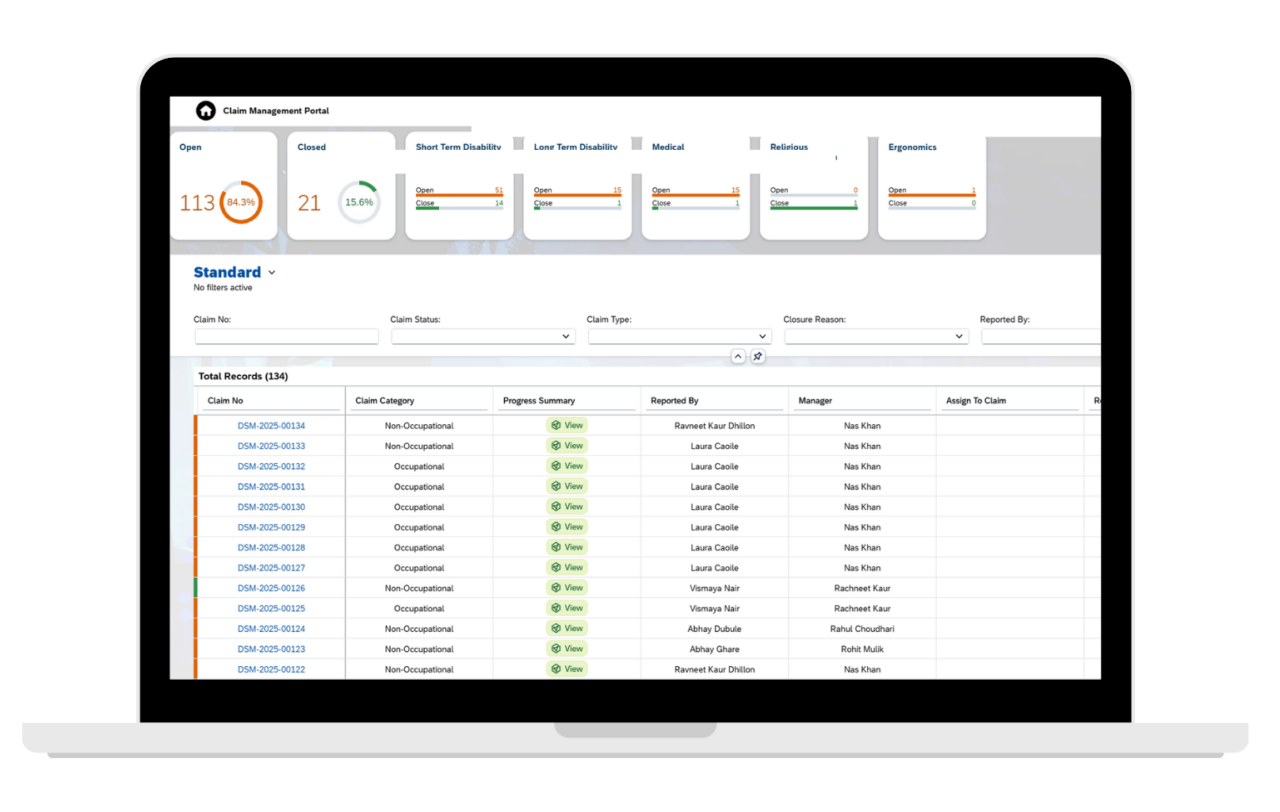
End-to-end automated case lifecycle management
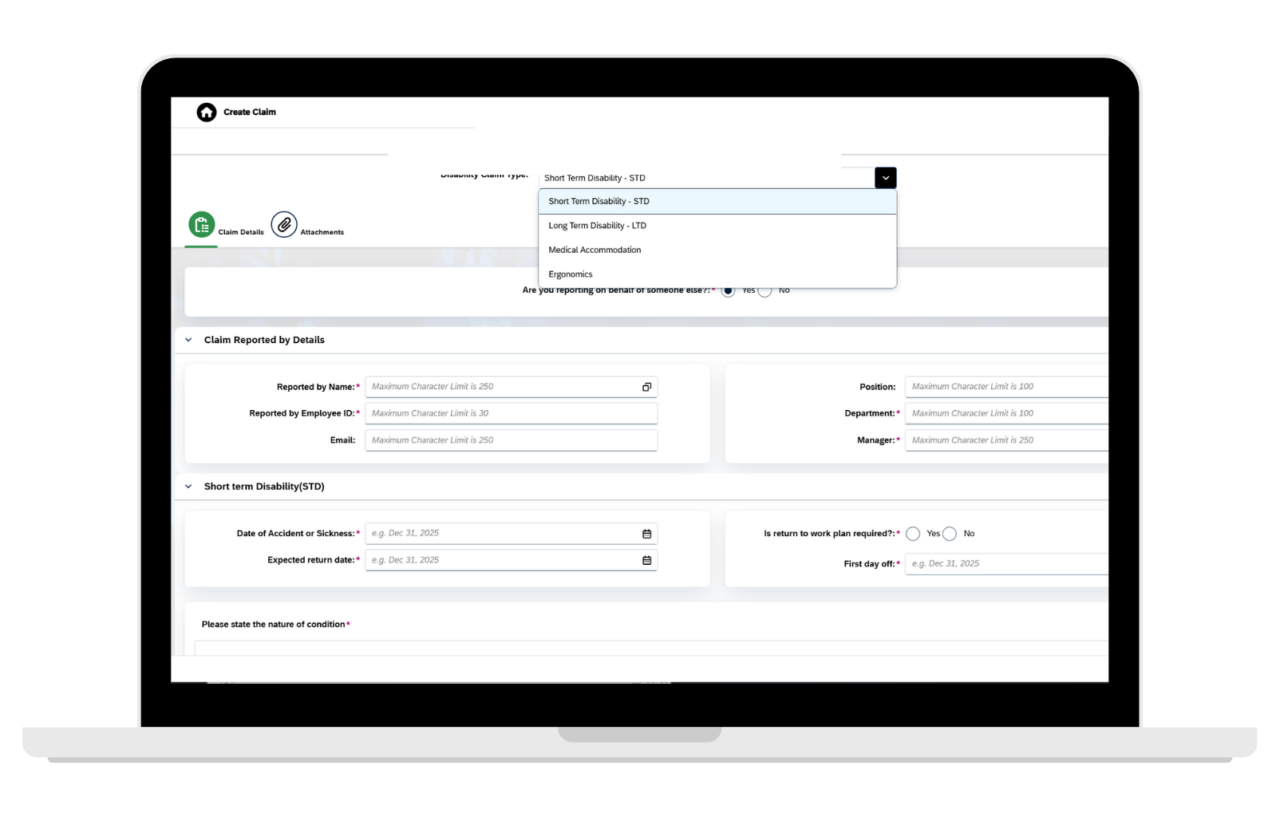
Manage the full case for any type of claim request such as STD, LTD, medical leave of absence, ergonomics, telework, and religious job accommodations.
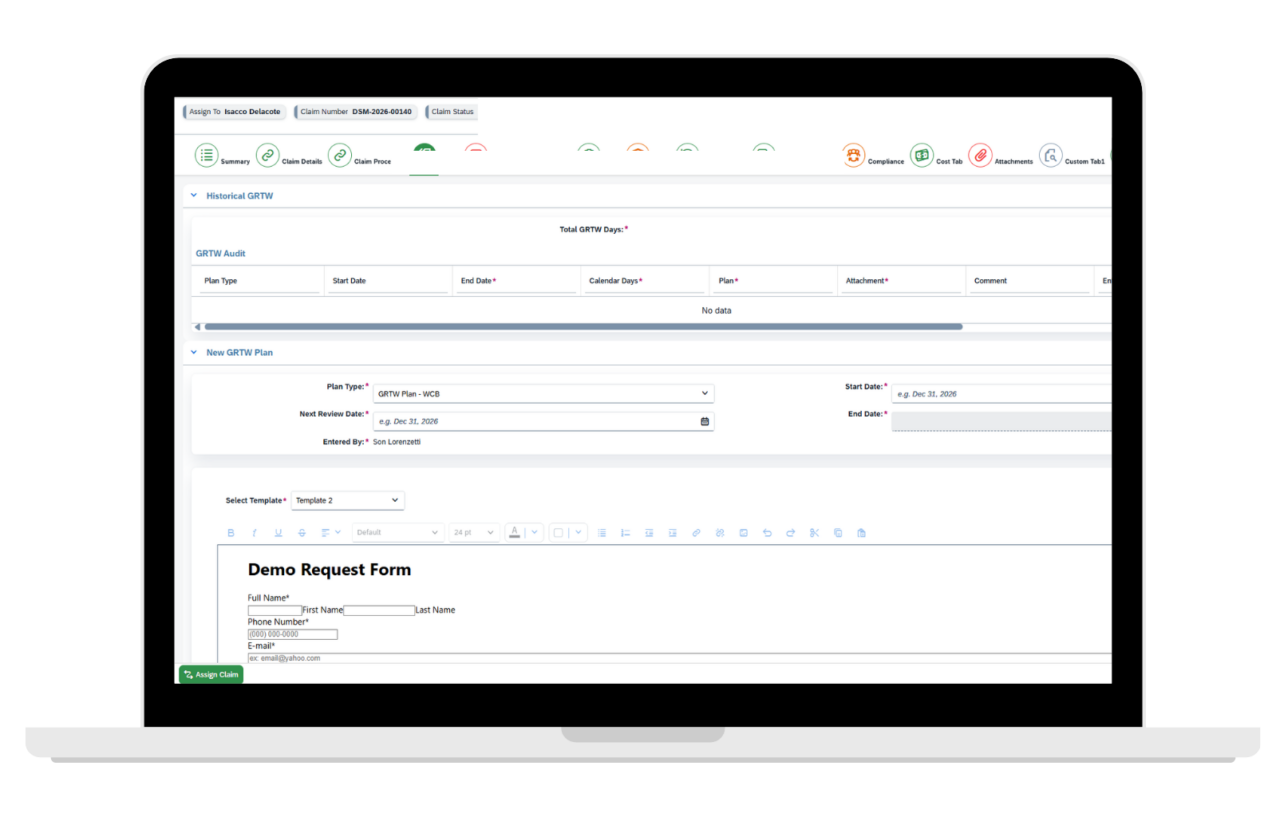
Structured & Standardized RTW plan creation and monitoring
Build return-to-work plans with defined milestones, modified duty assignments, absences tracking and lost time, work restrictions, job accommodations, regulatory form submissions, and restriction parameters. Makes it easy to track compliance with full audit trail.
Role-based data access control
Separate clinical and administrative views by role. Occupational health, HR, legal, union, and management each see only the right information for their role. This helps collaboration and coordination with different stakeholders while protecting sensitive data with role-based permissions.
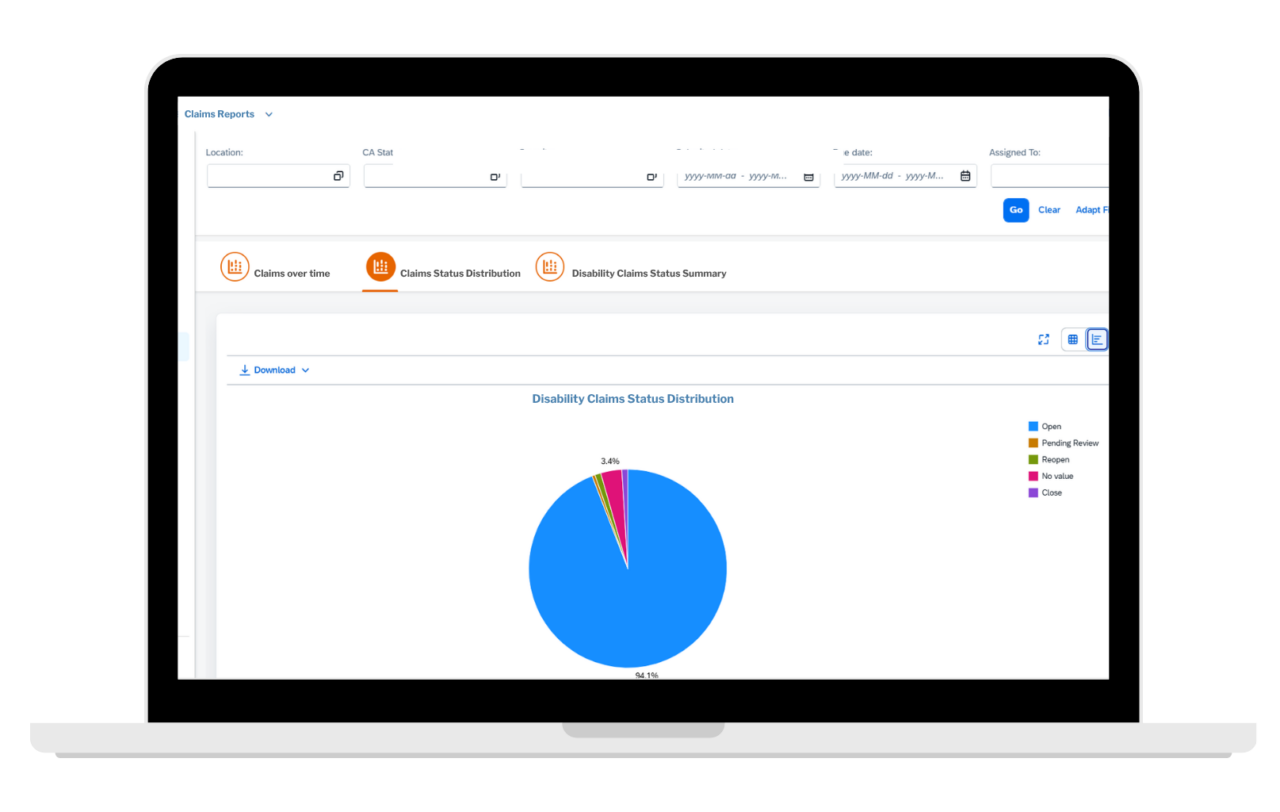
Real-time dashboards and analytics
Access a robust dashboard and analytics with real-time visibility across all cases. This empowers leadership to track relevant KPIs, case trends and compliance data across all safety incident and disability claim cases.
Employee self-service portal
Centralized portal enables employees to initiate requests, report concerns, access knowledge resources, and track case progress from submission to resolution.
What our clients say about us
The Platform That Connects the Full Compliance Chain
A disability claim is usually a result of something that happened much earlier.
It generally begins as a workplace safety incident. And if it’s not managed correctly, it can end up as a grievance or legal battle with costly fines and operational disruptions. Most platforms only manage one piece of the compliance puzzle.
Sodales, on the other hand, connects them all.

Incident record connected to the disability claim in one case

Disability claim case connected to job accommodation obligations & RTW plan

Employee Relations & Labor Relations processes connected to the same case as it evolves

HRIS-agnostic integration with HRIS and HCM systems
Integrate with the systems you already use
Connect to leading HRIS and HCM platforms like SAP SuccessFactors, Workday, Dayforce, Oracle, and UKG.
Go live in weeks with an AI-powered platform built for fast implementation. Hosted on secure SAP data centers to protect your data and keep everything in sync.


Connected Capabilities with Incident Management
Disability management connects occupational injury cases in incident management with job accommodations, return-to-work, grievances, and case management processes.
Non-occupational injury cases can be managed independently while using the same case management processes.
These modules connect directly to the disability case record and work cohesively as part of an integrated EHS and workforce management solution.

Capture incidents that trigger disability cases in the same system, so safety and HR work from a single source without data re-entry.

Manage modified duty, restriction-based job accommodations, and return-to-work plans in a connected record.
Manage grievances, time claims, and CBA processes in one system, with structured workflows, deadlines, and full case history tracked end to end.
FAQs
What is a disability management system and how does it work?
A disablity management system tracks workplace disability cases from claim intake through return-to-work (RTW), covering occupational and non-occupational injuries, STD, LTD, and medical leave in one record.
Employers use it to manage the compliance and job accommodation obligations that follow when an employee can’t work.
What's the difference between disability management and absence management software?
Absence management software tracks schedules time off, including PTO requests, leave approvals, and vacation balances.
Disability management software handles what happens when an employee can’t work due to an injury or illness. It includes the claim, compliance obligations, and return-to-work plan.
Sodales offers integrated disability and absence management that tracks workplace disability cases tied to the original safety incident. Enterprise HR teams often manage both through an integrated workforce compliance system like Sodales.
What is integrated disability and absence management software?
IDAM software is commonly built for insurance carriers managing claims and benefits payments.
However, for employers, it manages disability cases internally, such as tracking case type, documenting compliance obligations, and keeping records tied to the workplace events that triggered them.
Sodales covers 5 disability case types, including occupational and non-occupational injuries – STD, LTD, medical leave of absence, ergonomics, and religious job accommodations.
Each case is linked directly to the original incident record, ensuring teams never lose context.
How does disability claims management work in an HR system?
Our disability management system connects natively with core HR platforms like SAP SuccessFactors, Workday, Dayforce, UKG, and Oracle.
HR can open claims directly in the system, assign a case type, and manage the full case lifecycle from one portal.
Return-to-work plans, absences, work restrictions, modified duties, and claims history are tracked in the same record including task management for follow-up actions through to resolution.
How do incident management systems integrate with HR platforms?
Through pre-built APIs that sync employee data bi-directionally between the two systems.
Sodales integrates with SAP, Workday, Dayforce, Oracle, UKG, and others, making it easy for HR teams to work from a single source of truth rather than handling data from multiple systems.
How can software help manage employee disability risk?
Disability risk for employers lives in three places: undocumented cases, compliance gaps between incident and claim, and untracked return-to-work obligations.
Sodales reduces that exposure by keeping the full case record in one system: incident details, case type, work restrictions, modified duties, RTW plans, job accommodations. Follow-up tasks are all documented against the same event.
HR teams have an auditable trail from the moment an incident occurs all the way to case resolution.
What tools do HR teams use for disability management?
Most HR teams manage disability cases through standalone point solutions that sit outside their core HR system, creating gaps between incident records, disabilty case documentation and return-to-work tracking.
Sodales handles disability case management within the same platform covering health and safety, employee relations, and labor relations.
Therefore, every case record, work restriction, and RTW plan is documented in one place from incident to resolution.
What should a disability case management system include?
A complete system needs case type classification, incident-linked documentation, return-to-work planning, claims history, and task management for follow-up actions.
Sodales covers all of these within a single HR compliance platform with each disability case tied directly to the originating safety incident so nothing is documented in isolation.
Are there any prerequisites to deploy Sodales for Enterprise Health, Safety and Employee Relations?
There are no prerequisites to deploy Sodales. Sodales integrates seamlessly with SAP SuccessFactors or SAP S/4HANA® and can also be implemented independently or with any other core HR system.
As a customer, am I required to implement all modules when I get started?
Put simply, no. Sodales is built as a process flow-based product, which allows our modules to be deployed independently of each other, but also has the modular ability to be deployed in conjunction with each other. As a Sodales customer, you can start with one module, and add others at any time, or you can begin with a combination of modules – whatever best suits your organizations needs and requirements. Common module combinations are incident and disability modules, or case management and discipline modules; but again, we can add modules that would best suit the needs of your business.
Is the Sodales platform extensible or customizable?
Sodales utilizes a customer-centric approach that allows you to configure the platform to meet your organization’s unique requirements. With robust administration capabilities, Sodales provides an agile platform to help you accelerate your digital transformation in HR processes for health, safety and employee relations. We do not require customization, rather, to offer our customers with similar functionalities and capabilities- our Solution Development Kit (SDK) allows for an easy extension of our product, for components like forms, drop-down menus, flows, reports, outputs, APIs, and more. With this, we can cater to company specific requirements of a customer, which will accommodate their location specific needs. Additionally, these changes are preserved during the upgrade processes.
With this series, we aim to provide you with valuable resources and expert advice on our solution. You will discover that at Sodales, we are passionate about helping highly regulated industries improve safety, communication, and employee experience with an all-in-one integrated software solution.
If you are interested in learning more about Sodales, and to learn more about how we take a proactive approach to health, safety, and employee relations, book a demo here and someone from our team will be delighted to show you how Sodales can help you seamlessly manage your business’ compliance and governance with one unified platform.
Can the end-user personalize the Sodales platform?
Yes, there are several editable functionalities available through the self-service capabilities, including but are not limited to, editing workflow timelines, letter templates, form templates, and report settings.
How does Sodales help organizations adhere to global health and safety requirements?
Firstly, identifying and understanding the specific health and safety regulations and standards that apply to your industry and location (as laws can vary based on region and industry) is key to understanding what you need to comply with as an organization. Sodales is available globally, as the solutions is built on SAP BTP, which means that it can host in any of the SAP data centres around the world. Currently, Sodales has customers who are hosting Sodales in Saudi Arabia, Canada, United States of America, Australia, and more. This means, Sodales can integrate with your organizations existing HR platform to help you adhere to your country-specific regulations, no matter where your organization is located, even if your organization is operating in multiple countries.
If we look at disability management for example, organizations in the retail sector or constructions sector, who are exposed to many elements (tall ladders, hazardous materials, forklifts, etc.), want to establish clear procedures for reporting to be able to thoroughly determine the root causes and take corrective actions. Sodales can seamlessly integrate with OSHA reporting requirements, short-term disability and long-term disability requirements, and provide compliance packages which can then be independently and seamlessly deployed.
One crucial compliance module that Sodales makes available, includes requirements sought by the Accessibility for Ontarians with Disabilities Act (AODA) and the Americans with Disabilities Act (ADA) – two different sets of accessibility regulations that aim to ensure equal access and opportunities for individuals with disabilities. Non-compliance with these acts can result in penalties, lawsuits, and court-ordered remedies. It is important for organizations to understand and adhere to the specific accessibility standards and requirements that apply to them under these laws, location dependant.
No matter the location, specific labor relations needs, or union specific rules, with Sodales’ compliance modules and disability management solution, the full breadth of capabilities can help your organization adhere to any compliance requirement.
How does Sodales help labor organizations adhere to compliance requirements?
As organizations grow, compliance requirements tend to get more complex, according to an article published by Alp Consulting; compliance is everywhere, whether you’re dealing with payroll, or discrimination or harassment, ensuring that your compliance processes are adhered to is crucial for safeguarding the interests of the organization and its employees.
If we look at highly unionized organizations in the utilities sector, higher education sector, or public sector, these organizations are bound by compliance and key employee processes as stated in their collective bargaining agreements (CBA); collective bargaining agreements are the baseline engine and driving force for those processes as they outline terms and conditions of employment, including wages, working hours, benefits, grievance procedures, and more. Maintaining compliance within unionized organizations becomes complex with multiple unions and multiple collective bargaining agreements that require different processes for grievances, seniority, and job bidding. With Sodales, representatives from these labor unions can monitor and ensure employer and employee compliance with the collective bargaining agreement, using tools from the Sodales software that manage inspections, audits, reports, job bidding, and more.
In addition, if an employee or employer needs education on their collective bargaining agreements provisions to ensure they fully understand it, Sodales’ CBA management tool ensures that employees understand their rights and responsibilities under the agreement, so when, for example, an employee files a grievance or discipline and refers to a clause in an existing CBA, the management tool will pull the clause directly from the contract manager to ensure it is a concise and valid reference.
It’s simple, with Sodales, simultaneously managing multiple unions, multiple collective bargaining agreements, company specific rules, and government laws, it becomes seamless and easy.
What type of training does Sodales provide when we implement the product?
Sodales has an extensive methodology when it comes to training. Our training is provided based on user roles and target groups, including, role-based training for business users, admin users, and more; this training is provided at different stages of the implementation process.
Once I implement the Sodales product, how will you support me?
At Sodales, a support portal will be made available 24/7 for all licensed users; following the guidelines as set out in the SLA, between Sodales and the customer.
Purpose-built for highly-regulated industries
Make faster, more informed decisions with industry-specific content based on unique industry regulations and expertise. Consistent, standardized processes promote well-being and engagement– and ensure you’re always on the right side of compliance. When you put people at the heart of your business – you can support, protect and empower them in even the most challenging work environment.


Keep Disability Cases and Return-to-Work Plans Connected
Manage accommodations, return-to-work plans and disability case activity in one system without losing context between people, records and workflows.