
Home » Platform » Health & Safety » Incident Management
Incident Management
EHS Incident Reporting Software
Record, investigate, and resolve workplace incidents, near misses, risks and hazards in one platform. Auto-generate your OSHA and WSIB forms with pre-built, province-specific templates.
Investigations and corrective actions remain connected to the original incident record.
- Designed for Enterprise EHS and HR Teams in regulated and high-risk industries.


Most Common Failures in Safety and Incident Reporting
Safety incidents in the workplace can lead to reactive, inconsistent processes instead of standardized, compliance-driven measures. Incident reporting becomes fragmented, investigations begin to lack structure, and when claims are filed, teams have lost context on investigations and corrective actions, causing them to do extra work.
All the while they are missing regulatory reporting deadlines and unintentionally exposing the organization to HR compliance risk.
-
Incidents go unreported until they escalate into claims
When reporting incidents require employees to access a computer, login, or complete a paper form, incidents dont get reported.
Near-misses go unlogged and minor injuries become claims weeks later without a documentation trail. This holds the organization liable without any defense during an audit or when the case evolves. -
Investigations close without finding the real cause
Without structured root cause analysis, investigations often end up as notes in a text box.
Corrective actions are tracked in spreadsheets or not at all.
Without a clear link to the original incident, hazards persist, leading to repeat incidents and no clear accountability.
-
OSHA and WSIB forms pulled together manually before every audit
Compliance forms aren’t generated from incident data and must be rebuilt for every audit, creating duplicate entries.
Teams spend days consolidating files across multiple system before inspections.
Errors are inevitable, increasing the risk of filing gaps in regulatory reporting.
-
No visibility into incident trends until something escalates
Safety, claims, and return-to-work data sit in separate systems or scattered documents with no real-time visibility into trends.
Patterns only become visible after they’ve already caused repeat incidents or compliance issues.
An EHS Incident Reporting System for Faster Investigations and Fewer Repeat Incidents
Organizations running incident reporting through Sodales see faster investigations, fewer repeat incidents, and audit-ready compliance documents for all of their sites; incident management remains connected at all stages.
Incidents are captured early and linked to the employee with full context, audits have a complete paper trail, and investigations consistently identify root causes, which lead to standardized corrective actions.
Region-specific compliance forms are generated automatically, and a clear visibility into trends (before they become risks) makes compliance easier, and reduces the number of total safety incidents.
Every incident reported at the point of occurrence
Mobile reporting with offline sync capabilities means field workers log incidents from the jobsite without needing access to a computer. Near-misses are captured and reported early before they become injuries.
Root cause identified and corrective actions enforced
Structured root cause analysis, 5–Whys, and Ishikawa frameworks are built into the investigation workflow. Corrective actions are assigned, tracked with due dates, and linked to the safety incident record in the system.
OSHA, WSIB, and WCB forms generated automatically
Compliance forms auto populate from the safety incident data that already lives in the system. Instead of rebuilding everything before an audit, teams are working from complete, audit-ready records.
Real-time visibility across incident types and locations
Safety, disability claims, and return-to-work data lives in one interconnected system. Dashboards show trends, high-risk areas, and recurrence patterns across health & safety compliances before they escalate into regulatory findings.
Core Capabilities
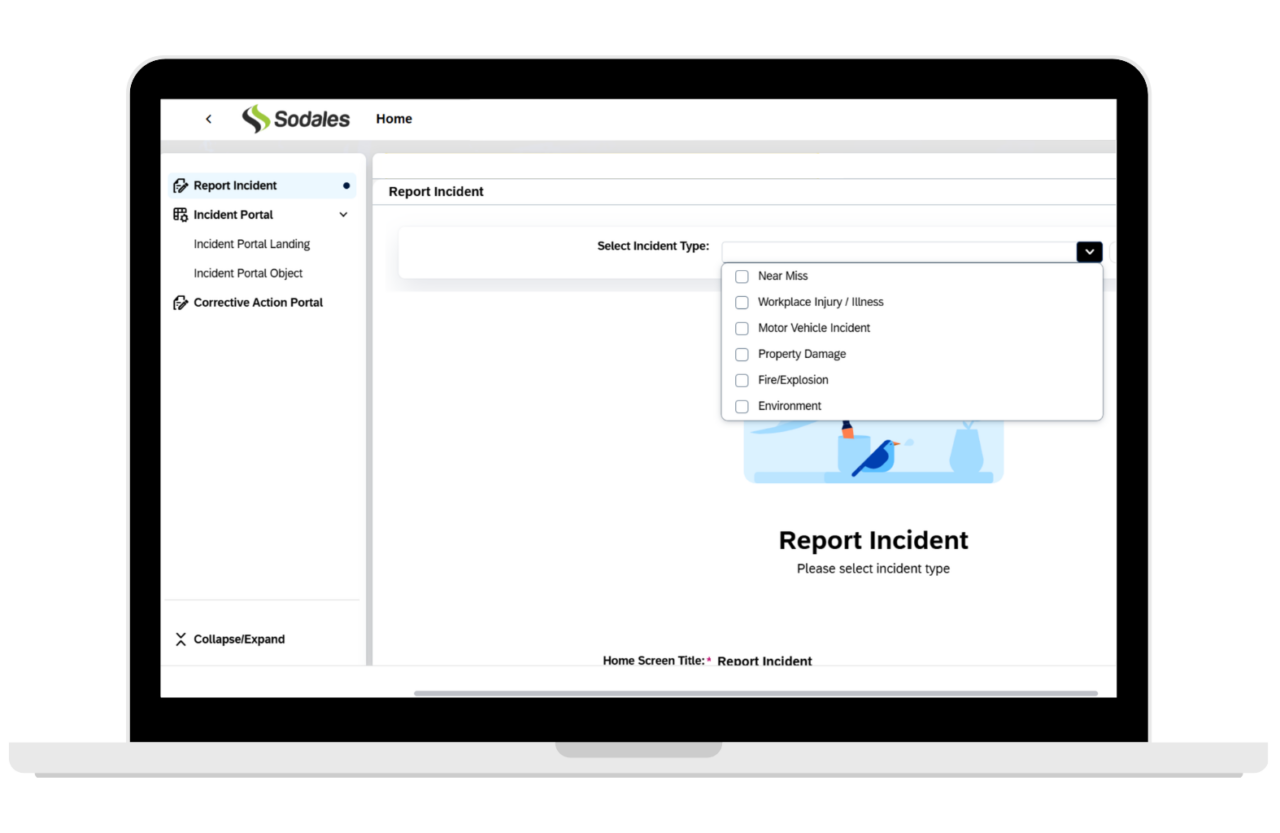
Our EHS incident management software allows users to report a safety incident, choose the incident type that applies to them, and track their case as it progresses.
Role-specific users can assign people for pre-investigation and formal investigation, analyze root causes, and arrive at corrective actions. The process is configurable based on your organization’s specific requirements and workflows, pre-built with best practices in high-risk and regulated industries to minimize compliance risk.
Role-based permissions also limit access and control who can see sensitive case data.
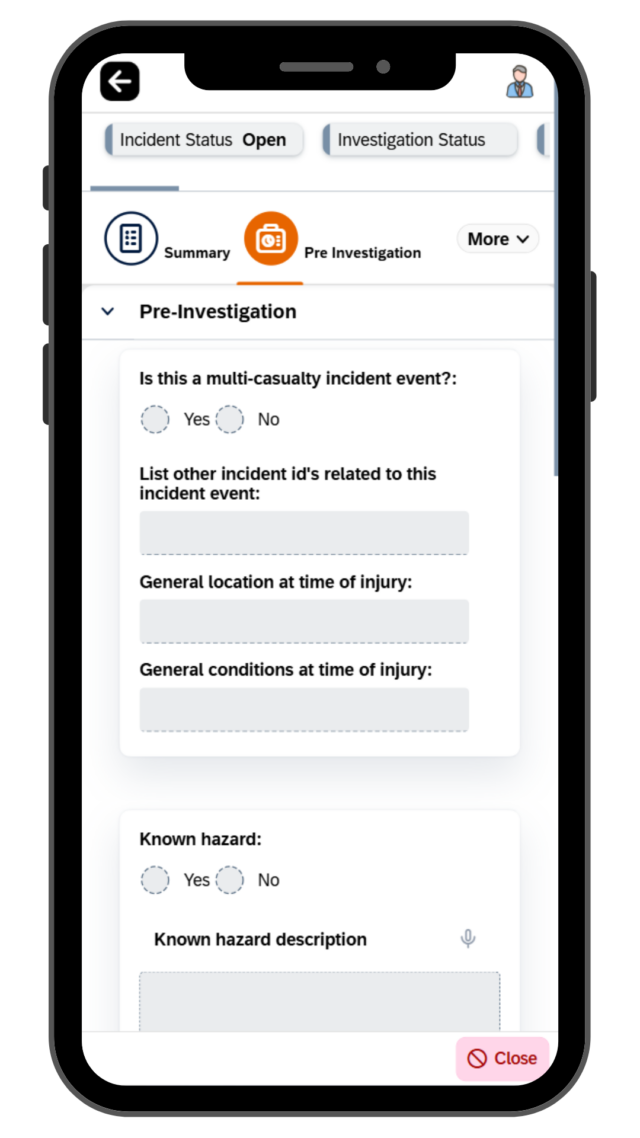
Mobile incident reporting and offline sync
Field workers can report multiple incident types, including near-misses, workplace injuries, vehicle collisions, and fire or explosion events even without internet connectivity.
Once connection is restored, data syncs automatically and single-sign on keeps access simple without requiring repeated logins.
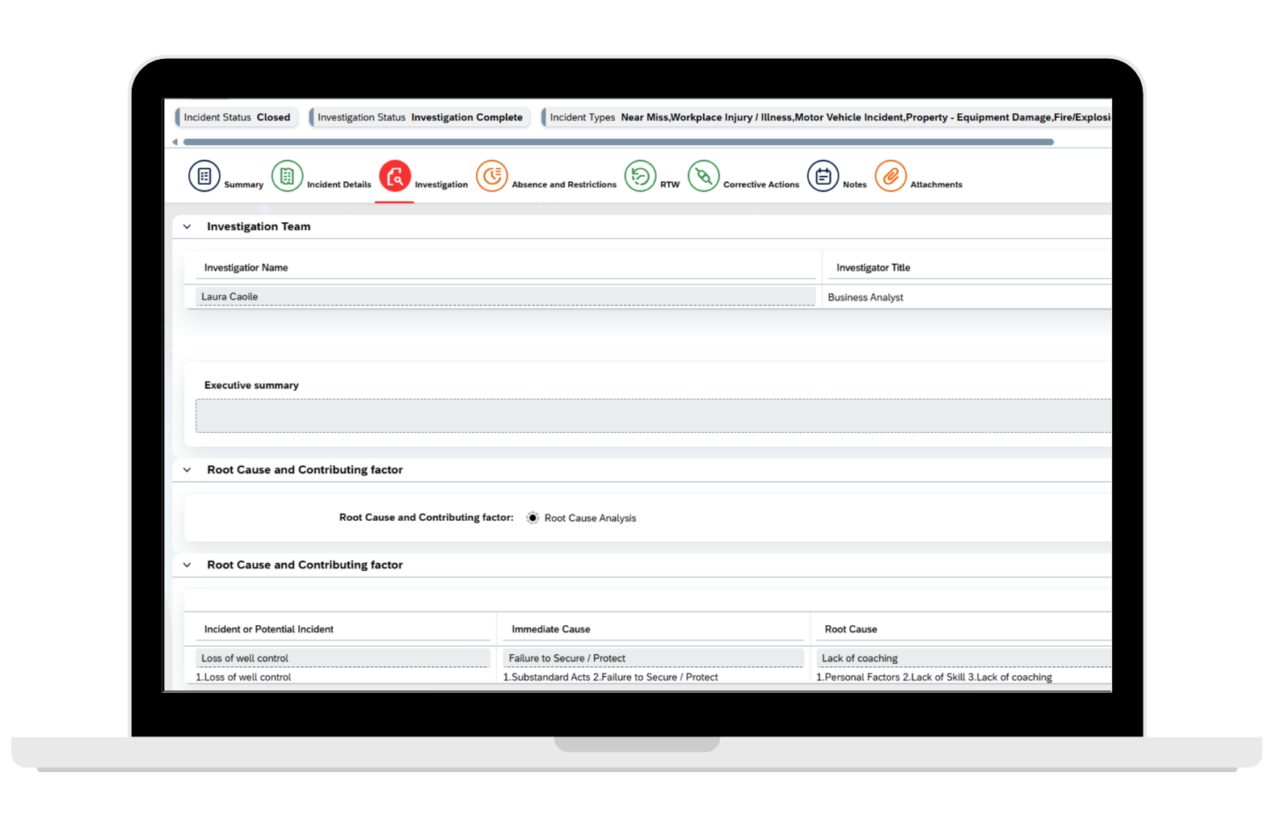
Root cause analysis & corrective action tracking
Built-in frameworks (5 Whys, Ishikawa) ensure a consistent approach to identifying root causes.
Corrective actions are assigned from the same record with clear ownership and tracking, and incidents are only closed once actions are completed and the issue is resolved.
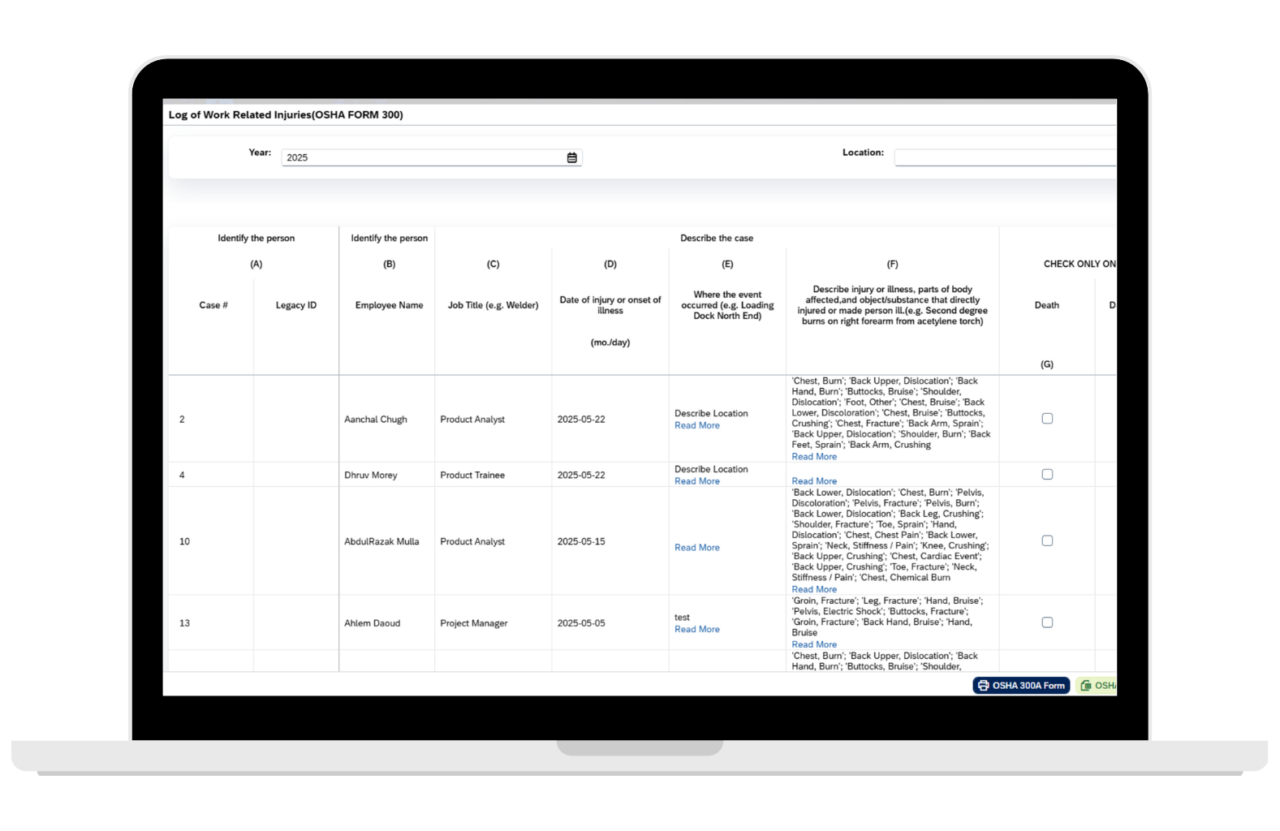
Automated OSHA 300/300A/301, WSIB, WCB, CNESST forms
Regulatory forms are generated automatically from safety incident data already in the system, eliminating repetitive admin tasks.
Multi-jurisdictional HR compliance is handled without compiling data manually.
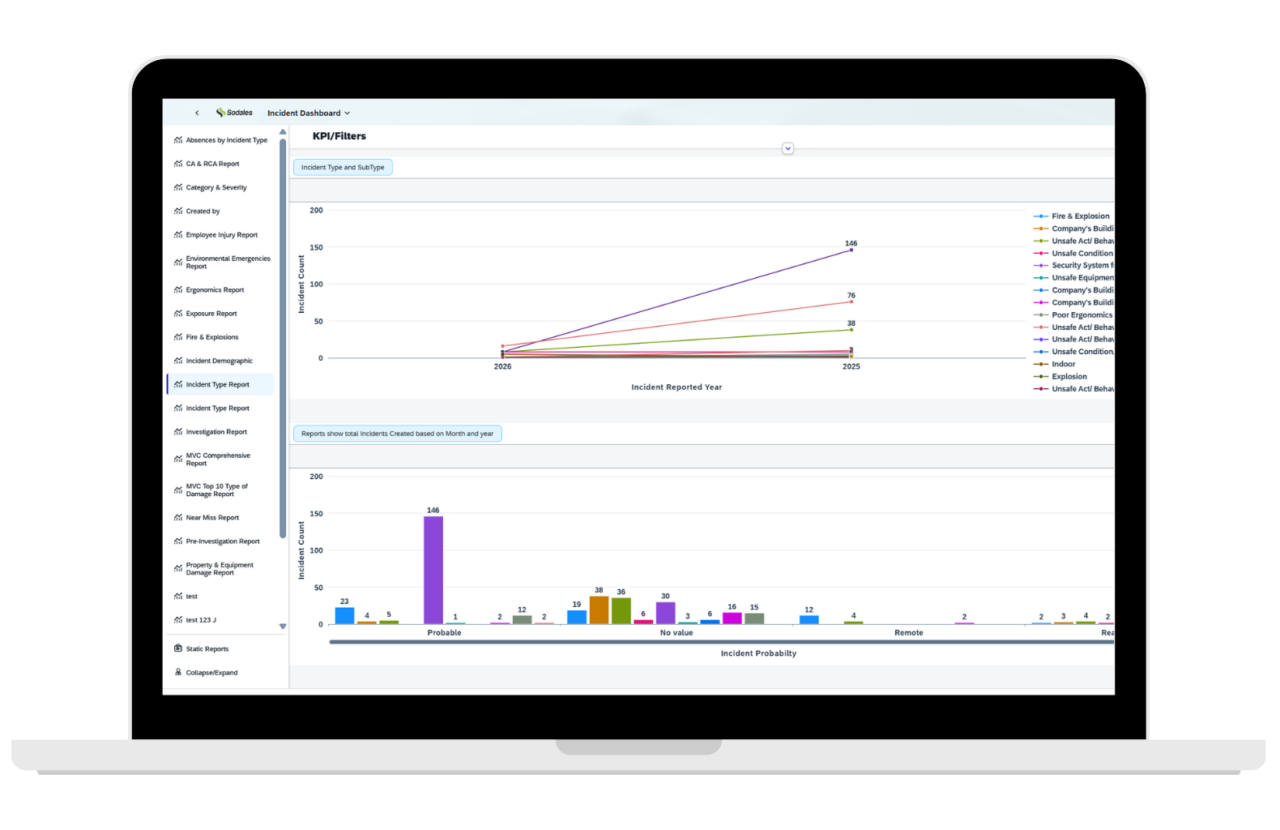
AI-enabled dashboards and reporting
Real-time visibility into incident trends, root causes, high-risk areas, common incident types, and recurrence patterns across locations without manual reporting.
Self-service admin portal
Centralized Employee Self-Service Portal enabling employees to initiate requests, report concerns, access knowledge resources, and track case progress from submission to resolution.
What our clients say about us
An Incident Doesn’t End with the Injury
An incident gets reported and investigated, but it also sets off a chain reaction.
A few days later, it evolves into a disability claim. The same details have to be entered again, documents need to be re-uploaded, and the cycle repeats when the return-to-work planning starts, especially if HR doesn’t have context from the original investigation.
At that point, the team handling the claim isn’t working from the same case anymore. And it’s also doing repeated work.
In Sodales, the case continues from the original incident.

Incident connects directly to disability and return-to-work
When a workplace injury becomes a disability claim, the case inherits the incident record.
Safety, HR, and legal work from the same case with one source of truth from day one without needing data transfer or filling version gaps between teams.

Job accommodation obligations flow from the incident record
As restrictions are set during return-to-work plan, job accommodation obligations surface in the same system.
No manual handoff between safety, disability, and HR teams managing modified duties

Labor relations and legal team has full context if a grievance or lawsuit is filed
If a safety dispute becomes a grievance or lawsuit, the incident record, disability case, and job accommodation history are all in one place.
Labor relations and legal teams walk into the first meeting with the full picture.

HRIS-agnostic integration with HRIS and HCM systems
Native integration with HCM and HRIS systems, including SAP, Workday, Dayforce, Oracle, UKG and others.
Employee data stays connected to the incident record in one platform. No duplicate entry or broken handoffs across systems.
Integrate with the systems you already use
Connect to leading HRIS and HCM platforms like SAP SuccessFactors, Workday, Dayforce, Oracle, and UKG.
Go live in weeks with an AI-powered platform built for fast implementation. Hosted on secure SAP data centers to protect your data and keep everything in sync.


Where Incident Management Connects to Everything Else


Manage modified duty, restrictions and return-to-work in one system.
Manage multiple types of grievances, legal escalations with applied CBA rules into your worflows.
Score hazards before they become incidents with a live risk register connected to inspections and corrective actions.
Centralize committee inspections, meeting minutes and corrective actions in one platform.
FAQs
What is EHS Incident Reporting Software?
It is a platform that helps organizations document, investigate and resolve workplace safety incidents.
Some incident types include: near-misses, workplace injuries, equipment damage, and fire or explosions.
Unlike general IT incident tools, EHS-specific platforms are built around regulatory compliance (OSHA, WSIB, WCB), root cause analysis, and return-to-work processes following a work injury.
Does Workday support incident management?
Partially – it supports employee relations incidents through its Marketplace, but has no native module for EHS.
Workplace injuries, safety investigations, and regulatory submissions fall outside its scope.
Sodales integrates directly with Workday to support EHS without replacing it as your core HR system.
How does incident management integrate with employee relations systems?
Integration works bi-directionally. Incident data flows into the ER system and employee records flow back into the incident module.
When a workplace injury is logged, the relevant employee profile is already there and the ER team sees the incident history without switching platforms.
Sodales connects to Workday through pre-built APIs, keeping both systems in sync without manual data entry.
Does Workday include a health and safety incident module?
No. Workday covers core HR, payroll, and employee relations but does not have a native EHS incident module.
Organizations that need injury reporting, investigation workflows, or regulatory submissions integrate an EHS platform with their Workday ecosystem.
Sodales covers the full incident lifecycle by connecting directly with Workday.
How do incident management systems integrate with HR platforms?
Through pre-built APIs that sync employee data bi-directionally between the two systems.
Sodales integrates with SAP, Workday, Dayforce, Oracle and UKG, making it easy for HR teams to work from a single source of truth rather than handling data from multiple systems.
Why is integrating incident and workforce data important?
Because incident context without employee context is incomplete. Knowing that an injury occurred matters less than knowing who was involved, their role, their history, and whether a pattern exists across a team or site.
Without integration, safety and HR teams handle data manually, which slows investigations, creates repoting gaps, and increases compliance risk.
Do incident systems offer real-time integration?
Yes. Modern EHS platforms sync incident and employee data in real time, so records update across systems the moment an incident is logged.
There are no manual imports, schedules syncs or lag.
Sodales maintains live data flow across SAP, Workday, Dayforce, Oracle, and UKG through pre-built APIs.
How does workers’ compensation tracking integrate with incident systems?
When an incident is logged, it automatically triggers the workers’ compensation workflow.
Sodales pulls the employee record and generates the required jurisdiction forms for OSHA, WSIB, WCB, and CNESST.
Claims get filed on time instead of falling through the gap between safety and HR.
Purpose-built for highly-regulated industries
Make faster, more informed decisions with industry-specific content based on unique industry regulations and expertise. Consistent, standardized processes promote well-being and engagement– and ensure you’re always on the right side of compliance. When you put people at the heart of your business – you can support, protect and empower them in even the most challenging work environment.


Talk to our Incident Management Team
Our incident management specialists will walk you through how Sodales fits your specific process in a 30-minute call.
Explore a short demo that demonstrates our system’s capabilities in a sandbox environment.
Make an informed decision by speaking to our Solution Advisors who will guide you through the entire process.