
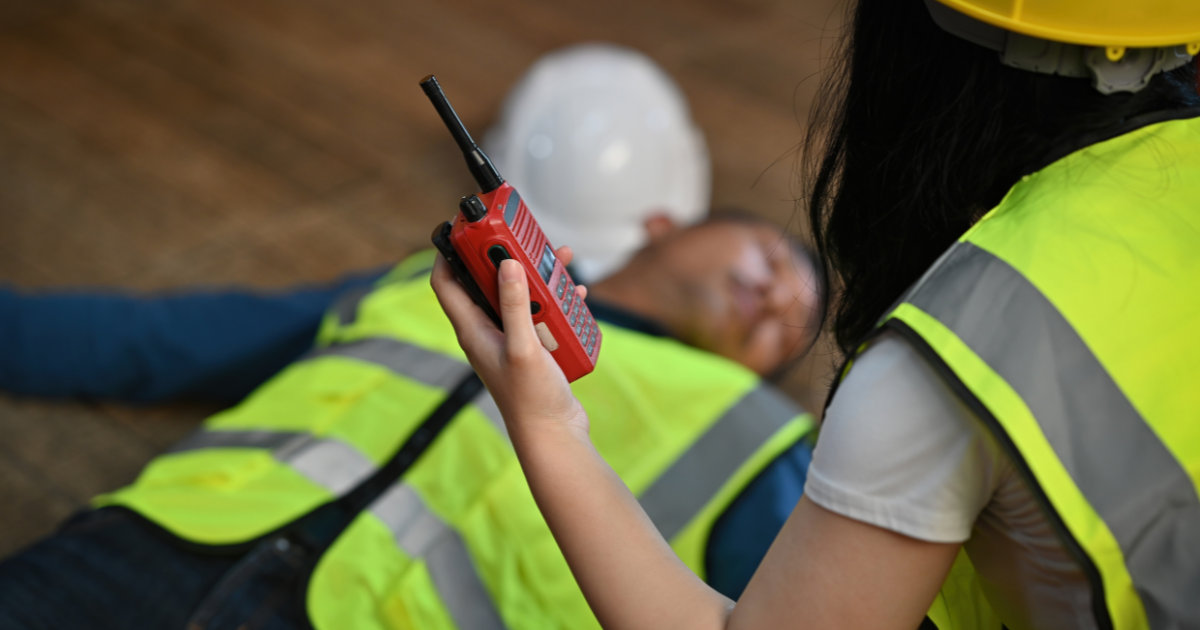
For EHS, safety, HR, and CHRO leaders that are searching for incident reporting software, they often find complicated systems that require IT involvement and take months to implement, without solving all their needs.
Reporting a safety incident in highly regulated workplaces becomes a struggle when HR managers need to juggle between multiple systems and scattered data living in multiple locations. This approach only increases compliance risks and creates huge blind spots for leadership.
For CHROs, the main focus is about reducing risk, improving HR compliance, speeding investigations, and having visibility across health, safety, employee relations, and labor relations compliances.
In this comprehensive guide focused on EHS and workplace safety incident reporting software, we’ll break down exactly what incident reporting software is, the best incident reporting software, why leading organizations around the world use it, what features really matter for workforce safety, and guidance for choosing the best software in delivering results.
Top EHS Incident Reporting Software: Quick Comparison
While the market is crowded with solutions for workplace safety incident reporting, they are not built the same. Next, we break down the platforms and how they can help your organization
1.Sodales
Best for: Enterprises that need to unify EHS incident reporting with employee relations, labor relations, and compliance workflows, all within one platform.
Sodales is designed specifically for CHROs, HR leaders, and safety teams in high-risk and highly regulated industries because it is built to unify proactive health, safety, employee relations, and labor relations compliances in one platform, connecting each case to HR-related compliance obligations, stakeholders, and corrective actions.
Sodales achieves this with a unified data foundation.
Key features:
- AI-powered health & safety, employee relations, and labor relations compliance in one platform.
- Handles all EHS, employee relations and labor relations in one platform: safety incidents, disability claims, job accommodation requests, investigations, return-to-work plans, return-to-office mandates, FMLA case management, OSHA reporting, Occupational Health & Safety Medical Services (OHS), Joint Health & Safety Committee (JHSC) management, workplace violence prevention, employee complaints, grievances, arbitration, time claims, CBA management, discipline cases, job bidding, and more.
- Unified dashboards with real-time visibility across locations, cases, and HR compliance trends, making the decision-making process easier.
- ERP-agnostic integrations with the most common HRIS and HCM, such as SAP, Workday, Dayforce, Oracle, UKG, etc.
- Rapid implementation, getting the system fully operational between six and eight weeks.
- Highly secure, hosted on SAP’s data centers.
From a user and buyer perspective, Sodales is designed for organizations that want more than only an EHS software. With it, your organization not only manages the incidents that have already happened but links them to the corresponded compliances as the case evolves, all within one platform, with access and collaboration to the right stakeholders and a strong audit trail for each step.
The result is no more missed meetings, fewer escalations, higher HR compliance, 360º visibility into one case, and real-time visibility to trends before they become risk.
Learn more about incident management
2. Cority
Best for: Large enterprises with established EHS, occupational health, and environmental compliance programs with an industrial focus.
Cority is known in the Environmental, Health, and Safety space with an industrial focus, offering a platform for traditional safety metrics and environmental compliance. It has incident and disability management, environmental safety, and OHS.
However, when it comes to holistic employee relations or labor relations workflows, it falls short. This leads organizations to seek other systems to cover this limitation.
Key features:
- EHS incident and occupational health management.
- Environmental compliance workflows.
- Safety metrics, reporting, and case tracking.
Limitations to consider:
Cority is a strong EHS platform. However, many users also report that the interface feels dated compared to other software. It lacks native integration engines, requires third-party tools or complex, custom API middleware that can create errors.
Analytics also do not have dynamic real-time predictive dashboard changes. While it’s competent for isolated lagging environmental and industrial hygiene tracking, it’s completely blind to the correlation between employee and labor friction with safety risks.
3.VelocityEHS
Best for: Industrial and operational teams focused on EHS compliance, chemical management, and safety workflows.
Velocity EHS is recognized for industrial EHS compliance (chemical data sheets, basic incident logs), particularly strong for ergonomics and chemical management but with no functional employee and labor relations footprint.
Functionalities:
- Incident reporting and investigation workflows.
- Corrective action tracking.
- Chemical and safety data sheet management.
- EHS compliance and safety program support.
Limitations to consider:
Users frequently find the navigation challenging, especially when trying to access complex incident reporting modules. Integration with HCM or HRIS relies heavily on high-cost, third-party middleware or custom-coded bridges.
Organizations have mentioned that sometimes the configuration stage comes with challenges, which delays the deployment of customized HR workflows.
4.Enablon
Best for: Global enterprises managing environmental risk, sustainability, safety audits, and operational compliance.
Enablon offers a comprehensive enterprise for macro-level corporate environmental risk, sustainability portfolios, and complex industrial safety audits. While it’s powerful, it’s not employee-focused.
For mid-market companies or organizations looking for an agile, unified HR and safety tool, Enable can be overkill.
Limitations to consider:
It lacks job accommodation management, workplace violence prevention, and employee relations and labor relations compliances.
For setup and administration, users consistently report that Enablon faces relevant challenges with a complex platform. For integration with HCM and HRIS uses rigid API data-handling limitations, resulting in disconnected data flows when communicating with standard HR payroll platforms.
The time of implementation goes from six to eighteen months, requiring dedicated project teams.
5.Intelex
Best for: Organizations that need incident reporting, investigations, corrective action management, and regulatory compliance tracking across multiple sites.
Intelex is an EHSQ platform that helps organizations manage workplace incidents. The platform is designed for injuries, illnesses, near misses, environmental incidents, and other events in the workplace.
Functionalities:
- Incident reporting and investigation management.
- Corrective action tracking and case management.
- OSHA and regulatory reporting support.
- Mobile incident reporting.
Limitations:
Customer feedback maintains that their reporting and dashboard configuration can be complicated for building custom reports. Other reviews state that the interface takes time to learn, especially for new users.
However, the main downside comes when HR teams need to manage job accommodation requests, employee complaints, grievances and arbitrations, FMLAs, and OHS, for which they need other systems.
6.EcoOnline
Best for: Organizations needing EHS, Chemical Safety, ESG, and Safety Training solution only.
EcoOnline enables organizations to report, investigate, and manage workplace incidents through an EHS platform.
It’s hard-oriented for chemical management, being mining, utilities, and manufacturing among their buyers. While it has been developed to make incident reporting easy and offer EHS data visibility in the workplace, it completely lacks employee relations and labor relations workflows.
Functionalities:
- Incident reporting and investigation management.
- Sustainability & chemical safety.
- Configurable dashboards and reporting.
- H&S training.
Limitations:
EcoOnline has limited employee relations capabilities and has not been built to be a dedicated employee or labor relations platform. Therefore, it lacks the capabilities to manage these compliance requirements connected to a safety incident.
Disability management is not as strong as Sodales. It also lacks return-to-work processes and job accommodation workflows. Organizations requiring to manage these processes may need additional systems.
7. EHS Insight
Best for: Organizations requiring incident reporting platforms with OSHA reporting, corrective action management, and mobile incident capture.
EHS Insight is known for helping organizations track, investigate, and resolve workplace incidents, ensuring compliance and visibility in their safety programs.
The platform offers similar core features as competitors such as incident reporting, near miss tracking, root cause analysis, corrective actions, OSHA recordkeeping, and mobile reporting.
Functionalities:
- Incident reporting and investigation management.
- Investigation and corrective action tracking.
- OSHA reporting support.
- Mobile incident reporting with offline capabilities.
Limitations:
Customer complaints mention difficulties with certain reporting and filtering capabilities when generating custom reports or analyzing specific datasets.
Industries with specialized requirements may also find some configurations and customizable options restrictive compared to more flexible enterprise platforms, like Sodales.
What Is Incident Reporting Software?
At its core, incident reporting software is a centralized, digital platform designed to capture, investigate, manage, and resolve workplace safety incidents in real time, with all its evolution along the process.
This has come as a solution for HR managers, who typically rely on paper forms, spreadsheets, email chains, and even messages to document workplace accidents.
This manual work is not only slow, but also requires a lot of time and increases the possibility of human error, opening the door to compliance failure.
Incident reporting software replaces these legacy methods.
Workplace safety incidents are built for events where the human is the center, usually with injuries to deal with. It is designed to manage workplace injuries, near misses, FMLA requests, OSHA reporting, and more.
While these are the typical capabilities of an incident reporting software, Sodales goes beyond with capabilities to manage job accommodations requests, return-to-work plans, disability claims, and Occupational Health & Safety (OHS).
How to choose the right EHS Incident Reporting Software
For Chief Human Resources Officers (CHROs), choosing the right reporting software requires considering your compliance obligations for EHS, workforce structure, industry complexity, and leadership visibility needs.
CHROs today are responsible for mitigating risks across safety and compliance. This is particularly more intense in highly regulated and high-risk industries, such as utilities, healthcare, public sector, transportation, and manufacturing, just to mention a few.
This is what you need to consider when selecting the right EHS incident reporting software for your organization:
Match the software to regulatory and compliance requirements
In highly regulated environments, incident reporting software needs to support documentation, audit trail, and reporting obligations to keep up with regulatory bodies like OSHA, which are constantly updating workplace safety mandates, while labor laws continue to evolve, complicating the scenario.
OSHA calls for preventive methods with proof, measuring not only lagging, but leading compliances too, to proactively manage health and safety.
Look for unified case management
When safety and HR data are living in silos, leadership lacks a holistic view of the chain of events to take improved measures. This leads to inconsistency, which ends up with a lack of trend visibility before they become risks. Having a tool that supports unified case management is essential.
Consider industry complexity
High-risk industries like healthcare, utilities, public sector, transportation, manufacturing, oil & gas, construction, and energy need more than a generic incident form.
When safety incidents are reported via disconnected systems that don’t reflect real-world operational risk, organizations have delays in investigations and corrective actions, which leads to unattended hazards in the workplace. This usually escalates into grievances when unions get involved or legal disputes for lack of adherence to policies.
How much prevention you want to implement
Many organizations are stuck in measuring incidents only after they occur. This is because they don’t have data to measure what could have happened. However, without identifying leading indicators, organizations are just waiting for the next workplace safety incident to occur to find out.
Without a unified incident reporting system, CHROs and their teams face important challenges that, if not properly managed, can negatively impact operations, legal, finance, and even reputation.
A stronger approach is to use a platform that connects incidents to the full case lifecycle, including investigations, corrective actions, job accommodations, return-to-work plans, grievances, and more, like Sodales does.
Key Features to look for in an Incident Reporting Software
What should then, the features CHROs should look for when evaluating incident reporting software? The right software needs to act as a compliance engine part of your process, rather than just a reporting tool.
Here are the features that are not negotiable:
- Workflow automation & case management
The system should be smart enough to automatically link incidents to the correct stakeholders. It should consider the type of event, if there was an injury, if the employee is part of a union, and if there’s an FMLA request. Automation ensures that the case is managed on time and with the appropriate response, without adding administrative burden.
- Investigation and root cause analysis
Capturing the incident in the system is only a part of the process. The incident reporting software needs to have built-in investigation methodologies, such as root cause analysis, the 5 whys, and fishbone diagrams to help the investigator and teams to properly identify the root cause and have all the pertinent information in the system.
- Real-time incident reporting
The ability to access and log incidents the moment they occur is critical, especially for high-risk environments, such as healthcare, utilities, transportation, and manufacturing. From the management perspective, leadership can immediately be aware of critical situations and understand what is happening in different locations.
- Mobile capability
For industries like oil & gas, mining, construction, manufacturing, and others, where the workforce is on the field, a mobile-first application allows workers to easily log all types of incidents, including near-misses, upload photos, and digitally sign the form from their mobile, ensuring not only real-time reporting, but also speeding up the protocols after an incident occurs.
- Corrective actions
The incident doesn’t end after it has been logged into the system. The lifecycle includes implementation of corrective actions, which can also prevent future occurrences. are a must. The system needs to assign, set deadlines, and track the corrective actions before an incident case is closed.
- Reporting and analytics
Leadership needs instant visibility into lagging indicators, such as injury rates, and leading ones, such as near-misses or hazard reports, to improve decision-making and better understand where the highest risks are. This data is vital to implement a proactive EHS approach.
- Audit trails and compliance records
Having the number of safety incidents and injuries without the audit trails, such as who reported the incident, who investigated it, why it happened, what actions were taken, and all the documentation to support these, is equivalent to not having a system at all. The system should hold compliance records ready for regulatory audits.
- Integrations with HCM and HRIS systems
This is one of the major differentiators for CHROs. The system must seamlessly integrate with the Human Capital Management (HCM) or Human Resources Information System (HRIS) they already use, such as SAP, Dayforce, Workday, Oracle, UKG. This saves unnecessary investment and synchronizes employee data with safety incident records.
Benefits of Using Sodales as your Incident Reporting Software
Implementing a best-in-class, plug-and-play safety incident reporting system like Sodales delivers measurable ROI across the entire organization, rather than just a team.
- Faster incident response: Automated alerts and mobile and offline capabilities ensure that the right managers and safety teams are notified when an incident occurs, reducing the time of response.
- More compliant investigations: A system helps to document evidence, assign investigators, track deadlines, capture root causes, and ensure corrective actions are completed before a case is closed, avoiding future occurrences.
- Improved safety outcomes: When it’s easy to report near-misses and track the corrective actions, organizations are more effective at eliminating hazards before they’re tangible risks. This helps HR leaders to move away from a reactive approach to a proactive approach, reducing workplace safety injuries.
- Reduced risk and costs: Preventing safety incidents and resolving employee relations and labor relations issues positively impacts workers’ compensation claims, legal fees, expensive fines, union strikes, operational disruptions, and reputational damage.
- Stronger compliance posture: When HR leaders can access and download regulatory-ready forms such as OSHA or FMLA directly within the system they use to manage incidents, they significantly reduce compliance risks, streamline reporting processes, and ensure consistency across all records.
- Data-driven decision making: CHROs can leverage analytics to identify high-risk departments, situations, or even managers, track the ROI of preventive safety programs, and make informed decisions.
Still Not Sure Which EHS Incident Reporting Software Is Right for You?
Choosing the right incident reporting software depends on your industry, workforce structure, compliance requirements, and operational complexity.
While these are the top incident reporting software options, selecting the right platform requires looking beyond the features and capabilities.
If you are evaluating options, talk to an expert for 30 minutes and get recommendations based on your workflows, systems you already use, and compliance needs


